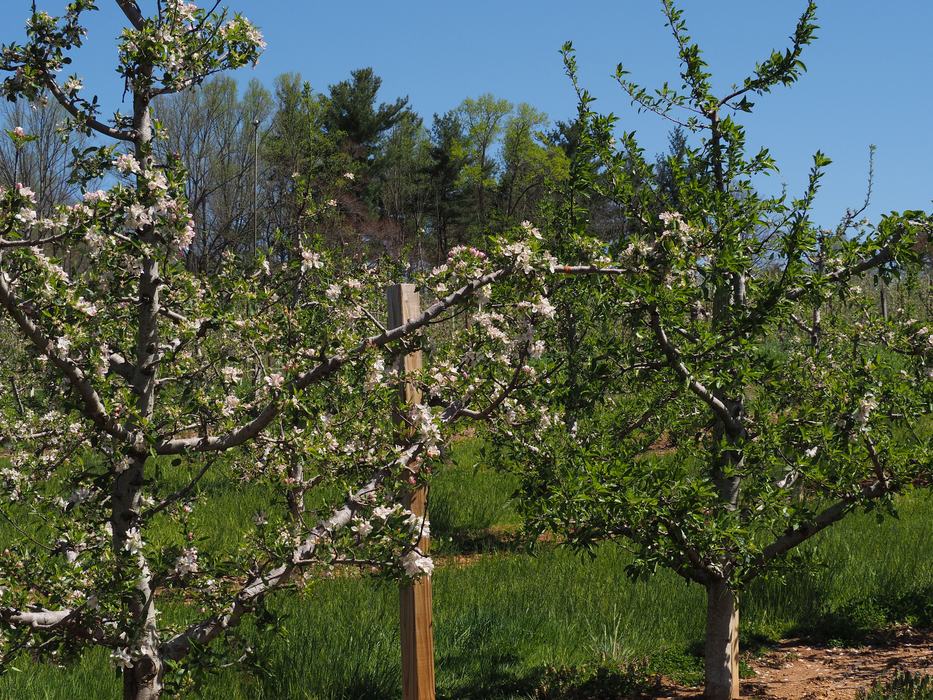
- early bud-break (green tip on Feb 28),
- blossom/bud mortality due to cold weather (up to 3 potentially damaging cold fronts),
- poor conditions for pollinator activity during bloom,
- a protracted bloom period,
- sub-lethal cold damage to spur leaves and/or fruit,
- high temperatures during the post-bloom chemical thinning window,
- cloudy and warm conditions during the rescue-thinning window,
- inclement weather during the rescue-thinning window, and/or
- > 20 inches of rain in a two-week period.
Return Bloom Programs
On most varieties, final fruit set is apparent and trees are insensitive to chemical thinner applications (>30 mm fruit size; ~ 6 weeks after petal fall). In general, this is an appropriate timing to initiate a return bloom programs. Since, products that promote return bloom also have thinning activity, return bloom programs should not be initiated until fruit size is >30 mm(i.e. insensitive to chemical thinners).In the southeast, there are two different programs that are used to promote return bloom:
1) A summer NAA program (Fruitone L®; PoMaxaTM; RefineTM, etc.) consists of four bi-weekly sprays of 5 ppm NAA. These applications generally occur in June and July. With summer NAA programs, the rate is constant regardless of variety. NAA can be included in cover sprays.
2) In the southeast, an ethephon program (Ethrel; Ethephon 2; MotivateTM, etc.) tends to be a single application at ~ 6 to 8 weeks after bloom. Ethephon rates are determined by several factors, including: variety, crop load, and history of biennial bearing (see table below for rates). As a result, this application must occur as a separate spray and requires an additional trip through the orchard. On varieties with a strong biennial bearing habit (Fuji and Cameo), a 2nd application of ethephon should be considered. The 2nd application occurs 2 to 3 weeks after the initial application.
Both programs have been effective in the southeastern US. McArtney et al. (2007) determined that four bi-weekly applications of 5 ppm NAA was generally as effective as a single application Ethrel. As stated above, NAA programs can be incorporated into cover sprays and use a consistent rate across cultivars. Conversely, single-application ethephon programs require a separate trip through the orchard and application rates are variety specific and/or subjective.
Plant growth regulators that promote return bloom can help mitigate biennial bearing of apple. While these products are useful management tools in apple production, adoption/use will not result in miracles. Blocks/trees with excessively heavy crop loads may not respond to return bloom sprays. Additionally, inconsistent/poor responses may be observed with weak trees, excessively vigorous trees, and unpruned/heavily shaded trees. Environmental conditions, such as water stress and/or heat stress, can also contribute to inconsistent responses.