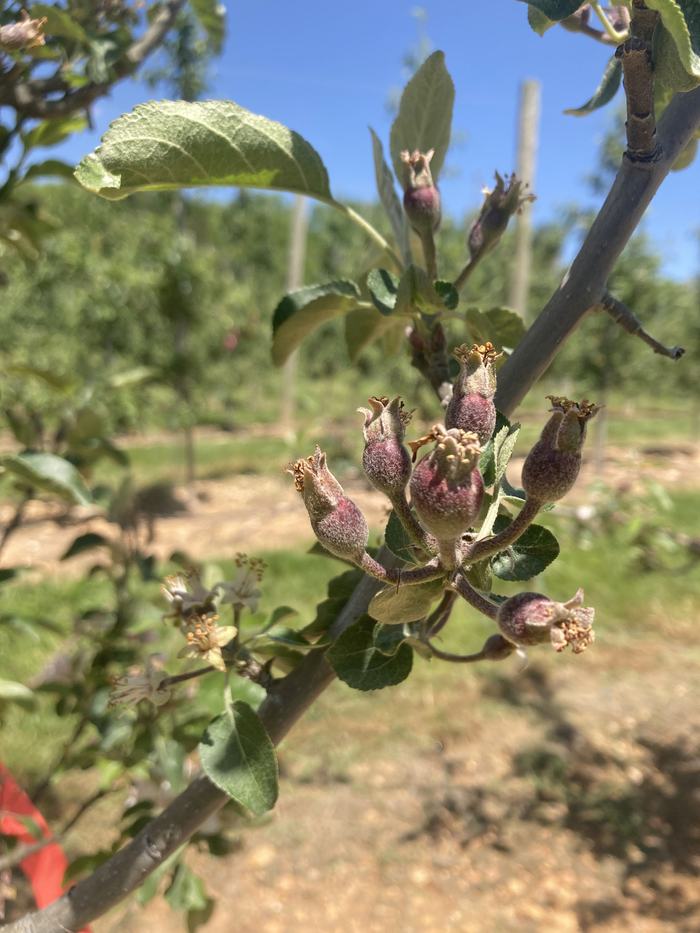
In our region, February was one of the warmest on record and promoted early bud development. Since March 1st, we've observed up to 10 nights with sub-freezing temperatures (tomorrow morning may make 11). Seven of these dates occurred between March 14th to March 21st, when trees ranged from green tip to pink bud stage. During this interval, two advective freezes (large cold air mass with high winds) occurred and were followed by a series of radiational frosts. Many sites were in the low 20’s for multiple nights during this interval.
While it is difficult to accurately summarize the impact of this series of cold events on the 2023 southeastern apple crop, here is my attempt: one size does not fit all. Some locations observed significant injury. Others made it through with full cropping potential. Sub-lethal injury is prevalent in many orchards (spur leaf damage, frost rings, etc.). Additionally, the heavy crop in 2022 resulted in poor return bloom of some cultivars (Golden Delicious, Fuji, etc.).
It is good that trees cannot read critical temperature charts. Despite all of this adversity, there are still orchards that have an excessive crop load. There was an excellent thinning window last week (moderately high temperatures and a mild to moderate carbon balance deficit) and some took advantage of this. However, some orchards/cultivars did not have adequate fruit size for post bloom thinner applications… or initial fruit set was still unsettled.Thinning in cool weather?
Based on the forecast, cool weather and rain is predicted over the next week. High temperatures less than 65° F are generally considered too cold for a successful application. Poor chemical uptake and thinning activity are observed in these situations.Please consider the following:- 6-benzyladenine based compounds (MaxCel®; Exilis® Plus; Exilis® 9.5 SC, etc.) have poor thinning activity when daytime high temperatures are less than 68 °F.
- NAA (Fruitone L®; PoMaxaTM; RefineTM, etc.) has some thinning activity at cooler temperatures. However, applying NAA at suboptimal temperatures increases the chance of pygmy (a.k.a. “nubbins” or “mummies”) fruit development.
- Carbaryl has some thinning activity at suboptimal temperatures. However, carbaryl alone is unlikely to do a complete thinning job when on moderate/difficult-to-thin varieties.
- Ethephon (Etherel; Ethephon 2; MotivateTM, etc.) has the reputation of being an erratic thinner. This compound is very temperature sensitive. Applying ethephon at cool temperatures may result in limited activity. As temperature increases, so does the thinning response.