This week, I've given up on offering fungicide suggestions based on the weather. Seems like I'm wrong every time! Furthermore, it rained for about an hour in South Asheville yesterday and at my house 5 miles away we stayed dry. That said, I'm pretty confident it's going to be hot across this week in western NC and there's a good chance a thunderstorm or two will come our way. At this point, Captan 80WDG (or a different formulation) should be the backbone of your fungicide program across all cultivars. If you're a hoarder and still have bags of ziram or ferbam hanging around, those are also fine options, but I don't believe either is available for purchase.
I received a question the other day about the maximum temperatures Colletotrichum fructicola and C. chyrsophilium, the fungi predominantly responsible for Glomerella leaf spot (and fruit rot), can survive. Around 86 F is the optimal temperature for these two species. Growth of these fungi will start to slow down around 93 F, but won't stop until the temperatures are around 100 F. So, while daily temps may hit the mid-90s, Colletotrichum does not sleep during the night, and you must keep the fungicide programs going.
Pivoting away from the GLS and fruit rot, I wanted to spend the rest of this post going back to a couple of old friends: flyspeck and sooty blotch (FSSB). FSSB are superficial, or cosmetic, diseases of apples found on the waxy apple cuticle. When showing a school group around, I usually lick or bite an apple with minor to moderate FSSB just to get a reaction. Often a little bit FSSB is no cause for worry as symptoms can be wiped away with a little elbow grease or when apples go through the pack line. However, severe FSSB can lead to downgraded apples destined for the fresh market.
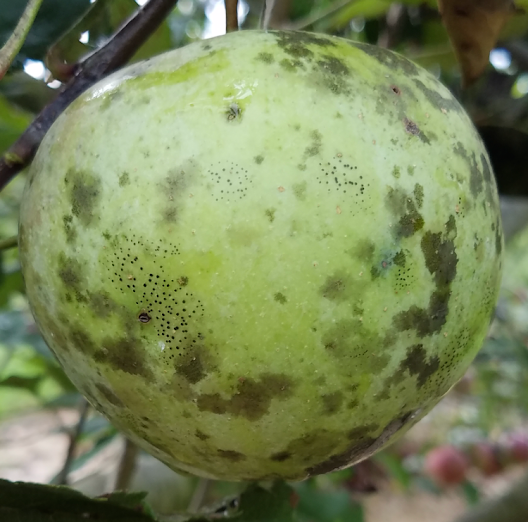
Sooty blotch appears as discolored gray blotches or smudges on the apple and in severe cases can cover a large portion of the apple as seen in the picture below:
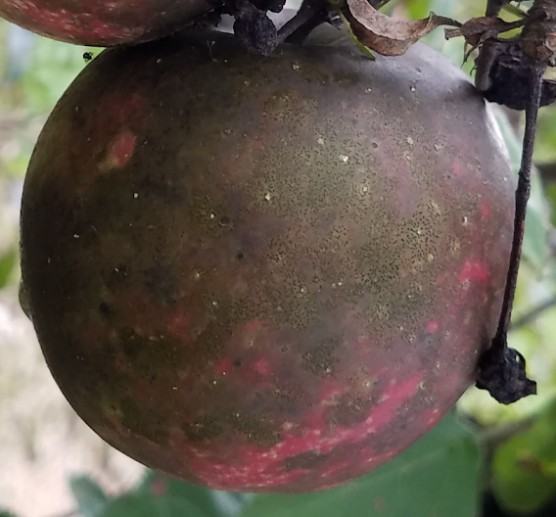
Flyspeck appears as more distinct small black spots on the fruit, almost as if a fly stuck their feet in ink and walked across the apple.
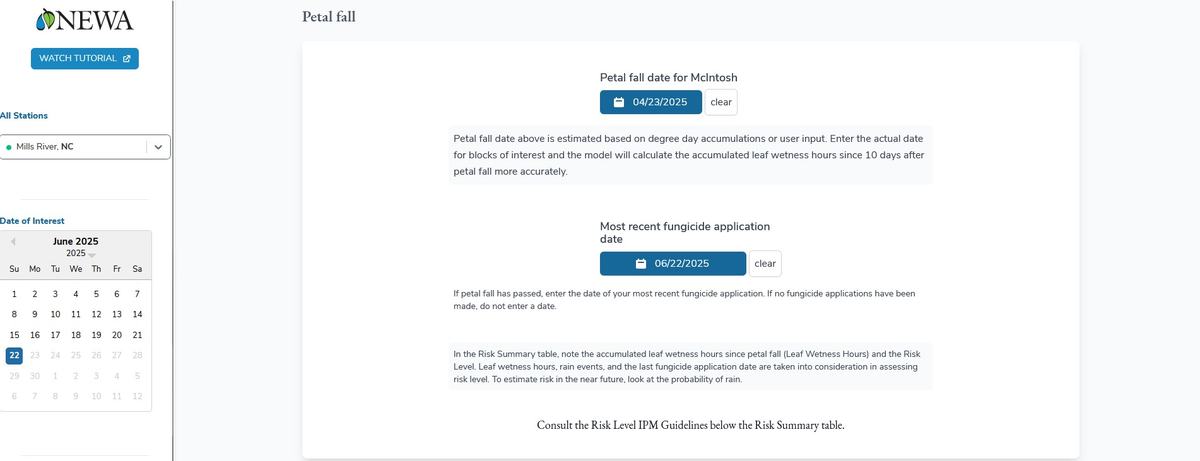
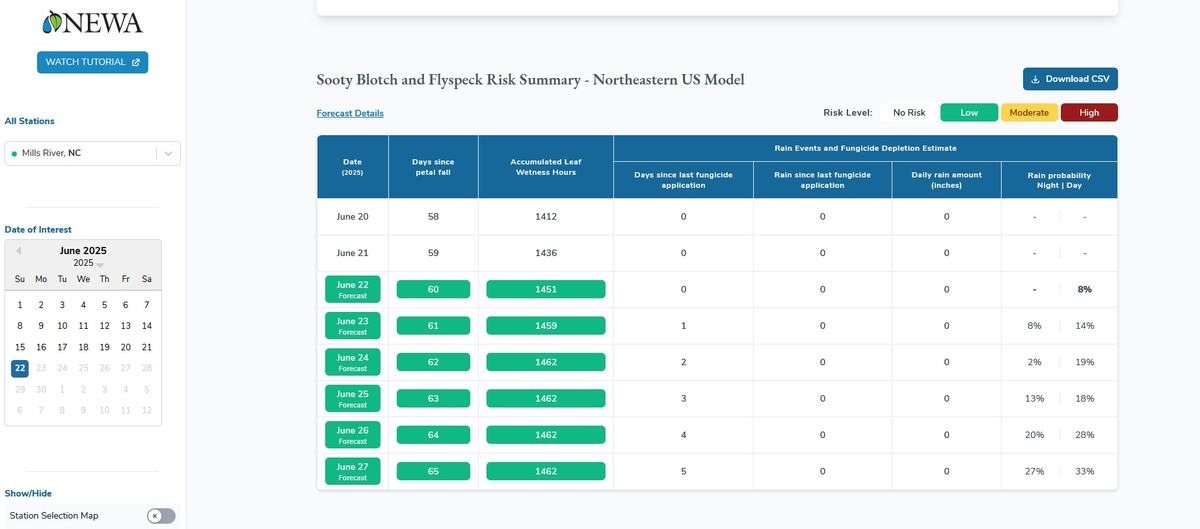
Over the years a lot of research has been done to determine ideal spray times using weather models. Once a spore lands on the fruit surface approximately 273 hours of leaf wetness are needed before seeing noticeable symptoms. Ascospores, the primary inoculum are typically released during petal fall each year. This event has already occurred and to date 1461 leaf wetness hours in Mills River, NC, while only only 409 LWH have been recorded at the Klimstra station in Hendersonville, NC and only about 361 in Polk County, NC, since the model started. If you want to check out your leaf wetting hour accumulation and FSSB risk, the NEWA forecasting system has a model for that. An example of the fly speck sooty blotch (fssb) model interface with NEWA is pasted below. There are only two inputs that need to be entered: Petal Fall date and Last Fungicide Application Date. We don’t grow many McIntosh down here, so I’d suggest entering your petal fall date for an early cultivar such as 'Gala' or 'Pink Lady'. After the initiation of fungicide sprays for the season for FSSB (think early cover applications immediately following petal fall), it’s really a residue game for keeping the disease under control. If you're spraying every 7-10 days this should not be an issue, but where you may not be spraying as frequently, you may want to consider using the model.
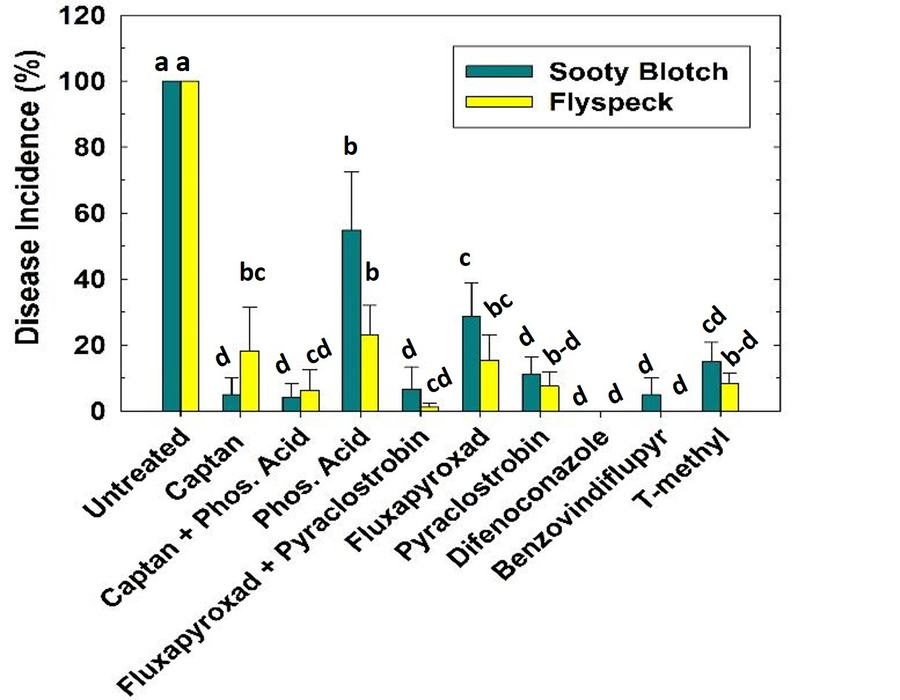
Lastly, when I first started at NC State, we did a lot of work if you recall evaluating non-rotational fungicide programs for the management of GLS and bitter rot in 'Gala'. During that period we also evaluated the efficacy of these fungicides for the control FSSB following two weeks in cold storage.
On 14 day intervals captan (5 lb/A rate of 80WDG) demonstrated high efficacy against sooty blotch and so-so (compared to other programs) against flyspeck. When the rate of captan was cut in half and ProPhyt was applied in tank mixture, control of flyspeck was significantly improved. Other fungicides that performed well included pyraclostrobin (a.i. in Merivon and Pristine), Inspire/Inspire Super, Aprovia, and Topsin. We did not screen Luna Sensation or Flint Extra that year, but I have no reason to believe they would be ineffective. If you're looking for some organic alternatives, Howler EVO and OSO (both manufactured by Certis) have performed solidly in trials throughout the eastern USA.
For this week, if you're looking for some extra "kick" or haven't included a single-site fungicide in your tank mix lately, consider Omega or Aprovia. You may want to hold off on Merivon or Pristine, but make sure to watch the forecast and consider applying either of these fungicides if more rain starts to enter the forecast.